NEWS
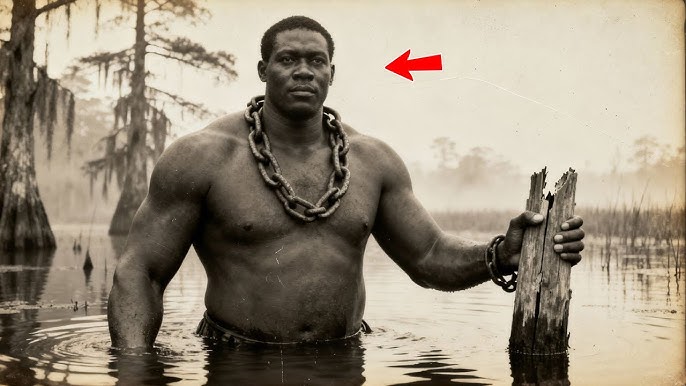
The Virginia Giant — The 7-Foot-6-Inch Enslaved Man Who Sent His Masters Fleeing in Terror


On the night of October 23, 1856, in the county of Halifax, Virginia, something impossible happened.
A man who had been exhibited as a circus animal, studied as a laboratory specimen and worked as a beast of burden for 15 years, finally broke his chains, literally.
Goliath was 2.18 meters tall. His hands could wield a man’s skull like a child holds a piece of dough. His shoulders were broad and he had to turn sideways when entering most doors.
And that October night, those hands that had carried impossible loads. Those arms that had been studied, measured, and ridiculed became instruments of the most brutal justice that the side of Halifax had ever witnessed.
At dawn, eight white men lay dead. The Blackwood family was wiped from existence, and all of the South learned a terrible lesson.
There is no chain strong enough to hold a man who has decided to die free rather than live enslaved. This is that story, and every word is true.
But to understand how Goliath became a killer, we must first understand how Corpelius Blackwood became a human being a weapon.

The auction square in Richmond, Virginia. September 1841. Corpelius Blackwood had come looking for men. Strong-backed men to work in his tobacco plant in the Halifax cove.
What she found was something she had seen in 40 years of the slave trade. A boy of about 15 years old, who was already 1.80 meters tall. But it wasn’t just the height, it was the proportions.
Arms that hung past his knees, hands the size of plates, feet that required custom-made shoes, enormous shoulders that looked deformed, the bastard was almost salivating.
Gentlemen, I present to you the rarest specimen you will ever see. It comes directly from the Dika region of Africa, a people known for their extraordinary height. But this one, this one, is special even among them.
Corpelius pushed his way through the crowd. Up close, the boy was even more impressive and terrifying. Those dark, intelligent eyes observed everything, assessing every white face in the crowd.
Can he work?” Corpelio shouted.
Work. So this black man can do the work of three men. I’ve seen him carry 600 pounds across a whole warehouse. 600 pounds without effort.
The bidding started at 3,000 pounds. An astronomical sum for a single slave. Corpelius offered 3,500. An owner of a South Carolina station offered 4,000. Corpelius bid 4,500.
The man from South Carolina hit his head and stepped back. Too rich for his fortune.
“Sold to Mr. Corpelius Blackwood of Halifax County for $4,500.”
The most expensive slave Corpelius had ever bought. But as he gazed upon those enormous hands and that imposing body, he had already calculated. He wasn’t just a farmhand. He was an attraction, an investment. This would make him rich.
The boy barely spoke English when he arrived at Blackwood Place. He only learned a few words on the stray ship during the voyage. His African name was unsuitable for Corpelius.
“Now you’re Goliath,” he quipped that first night, provoking laughter from his wife and two adult sons. “The giant who died at the hands of a shepherd boy. How fitting, don’t you think?”
Goliath, the name the boy would carry for the rest of his life, remained silent in the dining room. His head almost touched the ceiling. The slaves of the house looked at him as if he were a monster.
“Now you’re Goliath,” he quipped that first night, provoking laughter from his wife and two adult sons. “The giant who died at the hands of a shepherd boy. How fitting, don’t you think?”
Goliath, the name the boy would carry for the rest of his life, remained silent in the dining room. His head almost touched the ceiling. The slaves of the house looked at him as if he were a monster.
Master Blackwood’s youngest son, Jacob, threw a piece of bread at Goliath’s feet. “Pick it up, giant. Let’s see if you bend down.”
Goliath didn’t move. He didn’t even look at the pa.
Jacob got up, his face furious. “I told you to get him up, he said.”
—Jacob—Corelius’s voice was calm, but firm—. Sit down. You still don’t understand English.
“Then perhaps we should teach him.” Jacob grabbed a whip from the wall. The first blow struck Goliath in the shoulders. The second in the back of his legs.
The third. Goliath turned slowly. And for a moment, Jacob saw something in those eyes that made him back away. Something ancient and dangerous.
“That’s enough.” Corpelius stood up and stepped between his son and his inversion. “This black thing cost me $4,500. If you damage it, you pay for it. Understood?”
Jacob lowered the whip, but his eyes did not leave Goliath. “Yes, father.”
That night, in the basement where Goliath had been confined, the only place with a ceiling high enough to stand on, he touched the rocks on his shoulders.
It barely hurt. He had suffered worse on the ship when he arrived. He already knew he would suffer worse here. But he remembered Jacob’s eyes. The fear reflected in them when Goliath turned around.
“I should be afraid,” thought his mother tongue. “I should be very afraid.”
I’ve seen him choose not to hurt people when he could easily do so. There’s a difference.
Costrat shrugged. “Ask the master. If he agrees, I won’t object. It would be interesting to see what kind of children you have. Perhaps we’ll get more giants.”
The conversation with Corpelius was similar. He saw potential in raising his most valuable slave. If Naomi had gigantic children, each one could be sold for thousands. If not, well, nothing would happen.
—You have my permission—he told Goliath. —You can move to the small cabin behind the apartments. The one we use for married couples.
Goliath stared at him. “The chains? What about them?”
“Will I still be escaped by night?”
Corpelius reflected on this. Goliath had been a mortal slave for twelve years. He never caused trouble. He never tried to escape. The chains were only a precaution. A show for visitors.
—Fine. Yes, chains in the cabin. But if you try to escape, I’ll sell your wife to the farthest place I can find. Understood?
“I understand.”
That night, for the first time in his 12 years, Goliath slept without chains, with Naomi by his side, his small body pressed tightly against his enormous figure, breathing softly and uniformly.
He stayed awake for hours, putting his arm around her to protect her, staring intently at the ceiling of the cabin.
This, he thought, is freedom. Even in slavery, this moment is freedom.
I should have known it couldn’t last.
By 1856, Goliath and Naomi had been together for three years. They still had no children, which frustrated Master Blackwood, but he was patient. These things took time.
What Master Blackwood didn’t know was that Naomi had been using herbs to prevent pregnancy. Ancient knowledge passed down by her grandmother: wild carrot seeds and rue leaves. She took them every day in secret.
“I will not bring a child into this,” he told Goliath. “I will not give you another slave to sell.”
Goliath rejected him. But a part of him, a deeply aching part, still wanted him. He wanted a son. He wanted to embrace something that was his in a world where he possessed nothing.
In August 1856, the herbs stopped working. Or perhaps Naomi stopped taking them. Goliath asked which one. All he knew was that one morning she woke up, vomited, and then smiled through tears.
“I think I think I’m pregnant.”
Goliath felt something break in his chest. It didn’t break, but it opened like a door that had been kept closed for years, which suddenly opened wide.


VIRAL: BREAKS THE INTERNET WITH DARING FASHION MOMENT — FANS CAN’T STOP TALKING!

Secret double life of Kristi Noem’s cross-dressing husband Bryon: The pouting ‘busty bimbo’ photos and trove of explicit messages

Internet Buzz: 10 Private Photos of Serena Williams Allegedly Leaked Online, Click here to see more pictures

“Beyoncé Goes Viral Over Priceless Reaction to Party Confrontation” between Usher Raymond and Justin Bieber.

WWE Star Sasha Banks Breaks Her Silence: The Real Reason Behind Her WWE Exit

Beloved young dad and inspiring female ‘Air Force superstar’ among US heroes killed in Iran mission crash as all six are named

Kylie Jenner Stuns in Topless Vanity Fair Shoot, Opens Up About Love with Timothée Chalamet and Desire for More Kids

“Over 300 Days Into His Second Term: How Is Donald Trump Really Doing?”

How Israel lured Ayatollah to his doom… then blew him up with a missile from space

Megan Fox Sets Instagram Ablaze With Sultry New Photos That Have Fans Weak at the Knees

Tucker Carlson Torches Trump’s Iran Strike as “Disgusting and Evil,” Exposing Deep Cracks in the MAGA Base
